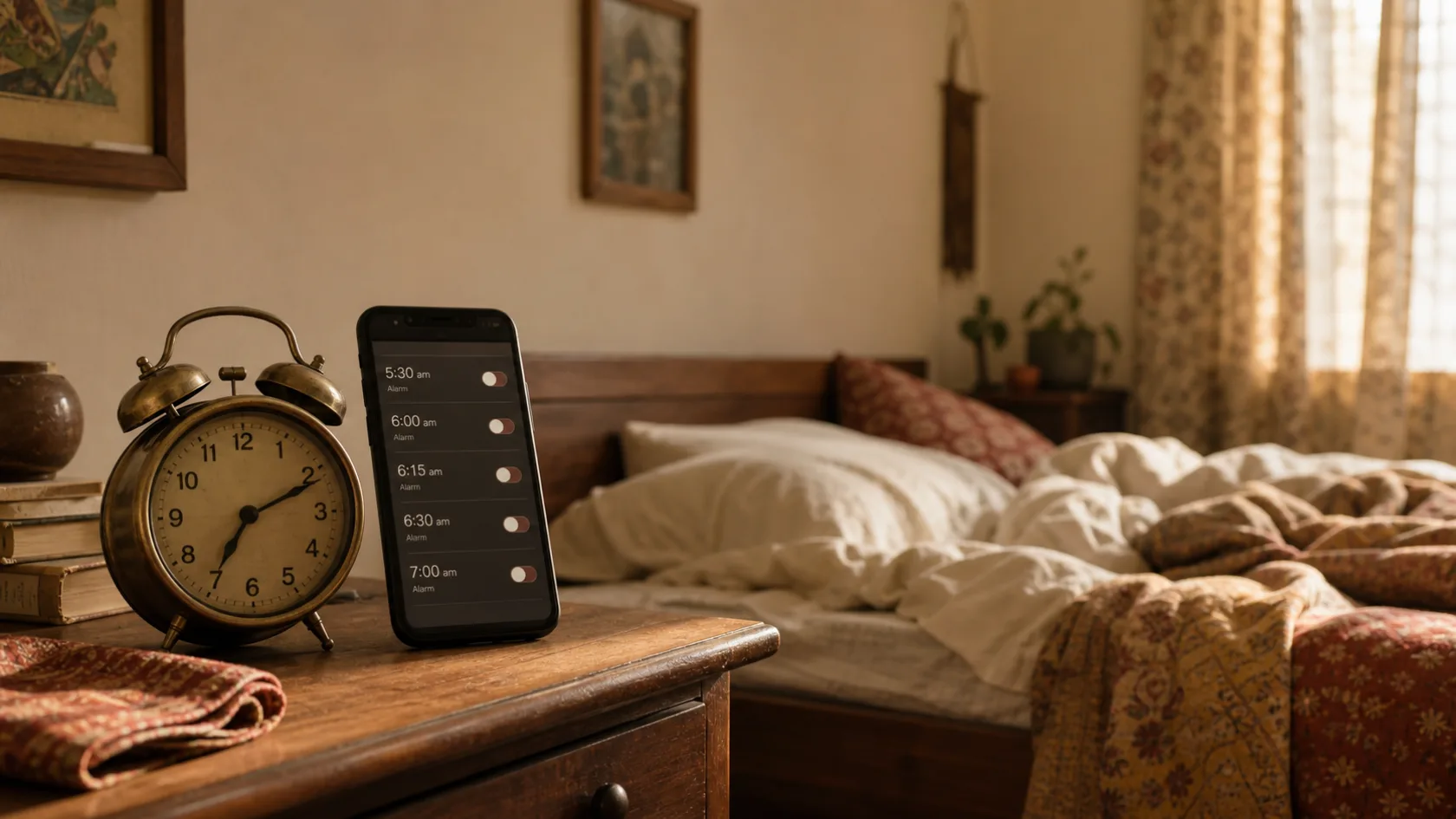
The row usually begins with good intentions: 6:30, 6:35, 6:40, 6:45. By the end of the week there may be another alarm at 6:27 “just in case”. Yet you still wake at 7:20, holding a phone you do not remember touching.
That does not automatically mean you need a louder app. Multiple alarms can fail for several different reasons, and adding one more rarely tells you which reason is yours.
The first alarm has lost its job
If there are five alarms behind it, the first sound is no longer a command to get up. It is an announcement that you can sleep for another five minutes. Your sleepy self learns the arrangement quickly.
This is also why moving the earliest alarm earlier can backfire. You have not created more morning. You have divided the last part of your sleep into small, unreliable pieces.
There is no need to feel guilty about this. It is simply a system doing what you trained it to do.
Some mornings begin with a sleep shortage
Before changing tones, count backwards from the alarm. The CDC says adults aged 18 to 60 generally need at least seven hours of sleep. If your schedule regularly offers five and a half, an elaborate alarm sequence is being asked to solve the wrong problem.
Try keeping a plain note for a week: bedtime, estimated sleep time, first alarm and the time you actually stood up. Patterns are more useful than a single terrible Monday. You may discover that the alarm only becomes invisible after late nights, travel or a run of long workdays.
You may be silencing alarms without forming a memory
Sometimes “I never heard it” means “I was not alert enough to remember hearing it”. The phone is beside your hand, the button is familiar and the room is dark. Stopping the sound takes less effort than becoming properly awake.
Check the alarm history or ask someone at home what they noticed. If the alarm rang and stopped, change the physical setup. Put the phone on a firm surface where you must sit up or stand to reach it. If you need help deciding the distance, read our guide to placing an alarm away from the bed.
Make one alarm sound like it matters.
Paathshala Clock uses familiar Indian sounds instead of another anonymous phone chime.
Try Paathshala ClockThe sound may be too familiar, too soft or simply muffled
A gentle tone can disappear beneath a fan, an air conditioner or early traffic. A phone under a pillow can make a loud alarm surprisingly dull. The reverse problem also exists: a harsh sound may startle you, but if you hate it enough you may become very efficient at switching it off.
Test the alarm in daytime from the exact place where it stays overnight. Keep the room and fan as they normally are. Then choose a sound with a clear pattern that does not also handle your messages and calendar. Our alarm sound guide for heavy sleepers explains what to listen for.
Replace the alarm ladder with a primary and a backup
Do not delete everything on the night before an important flight. Test the change on an ordinary morning.
- Set one primary alarm for the time you genuinely intend to rise.
- Add one backup five to ten minutes later.
- Use a distinctive sound for the primary alarm.
- Place the phone where turning it off requires movement.
- Choose the first action now: curtains open, light on or straight to the washbasin.
The backup is insurance, not the second stage of waking. If it rings every day, adjust the system rather than quietly accepting a new two-alarm routine.
Check the boring phone settings once
Run a test alarm while you are awake. Confirm the alarm volume, charging, speaker position and app permissions. Android battery controls vary by manufacturer, so make sure your chosen alarm app is allowed to work in the background.
If you use earbuds to fall asleep, check where alarm audio plays on your phone. If you share a room, vibration or a wearable may be a kinder backup than turning the volume up for everyone.
When the alarm is not the whole story
Sleeping through alarms once in a while after a short night is one thing. Regularly being unable to wake despite leaving enough time for sleep is worth discussing with a qualified healthcare professional, especially if you remain very sleepy during the day or wake feeling unrefreshed. Medicines, work schedules and sleep conditions can affect waking. A different ringtone cannot diagnose them.
Try this for four mornings
Use one main alarm, one backup and the same placement for four mornings. Record only three things: whether you heard the first alarm, whether you stood up before the backup and roughly how long you slept.
If it works, keep it. If it fails, you now know more than you did with seven nearly identical alarms. Change one variable next: the sound, the distance or the sleep window. Not all three at once.
You may also find our broader guide on why people sleep through alarms useful, or try the seven day snooze reset.