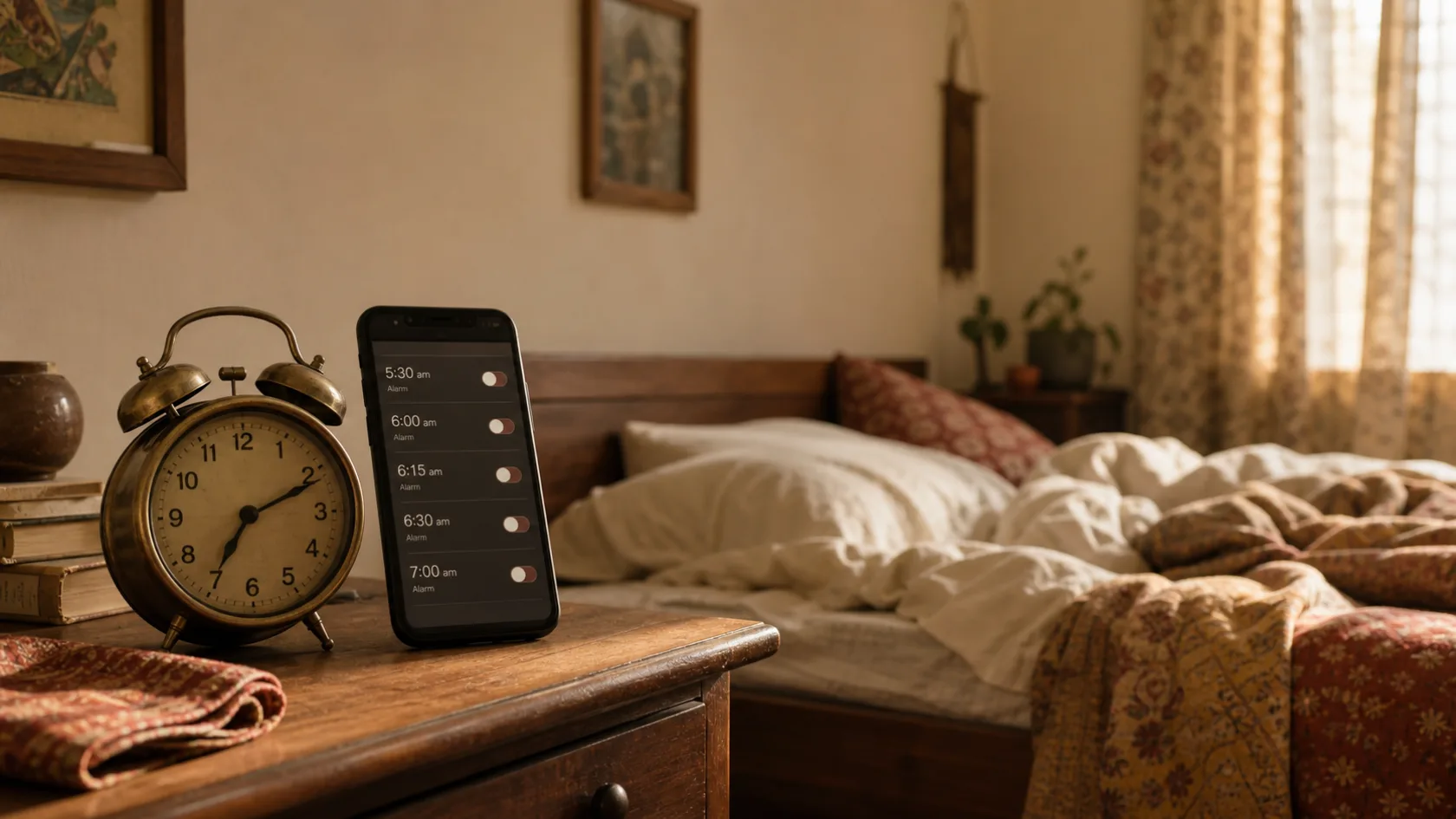
If your alarm list looks like 6:15, 6:20, 6:25, 6:30 and 6:35, you are not unusual. Plenty of people build a staircase of alarms because one feels risky and five feels safe.
The problem is that repeated alarms can quietly change the meaning of the first one. Instead of hearing, “It is time to get up,” your brain learns, “This is only the opening round.”
For most mornings, the better setup is one primary alarm and one backup. That gives you insurance without turning waking up into a negotiation.
The first alarm should mean something
An alarm works best when it has a clear job. If the first sound is followed by four more, it becomes easy to treat it as optional. You may still hear it, but you stop treating it as the moment the day begins.
That is why adding more alarms does not always create more reliability. It can create more opportunities to postpone the same decision.
Why one main alarm plus one backup usually works better
The main alarm is the real wake-up time. The backup exists in case you silenced the first alarm too quickly, slept through it or had a one-off bad night. It is there to rescue the morning, not to become the normal start of the day.
For many people, a backup five to ten minutes later is enough. It is close enough to protect the morning, but not so frequent that every alarm starts to sound disposable.
If the backup rings every day, that is useful information. It means the system needs work. Maybe the first sound is too forgettable. Maybe the phone is too close to your pillow. Maybe you are just not giving yourself enough sleep.
Make the first alarm easier to notice.
Paathshala Clock uses six familiar Indian sounds that stand apart from the usual anonymous phone tones.
Try Paathshala ClockWhen more than two alarms may make sense
There are a few cases where extra backups can be reasonable. An important travel day, an exam morning, a major interview or a schedule disrupted by illness may justify more redundancy for one day.
That is different from relying on five alarms every weekday. Temporary backup planning is sensible. A permanent alarm ladder often becomes a habit that weakens the first alarm instead of strengthening the morning.
What to change before adding another alarm
Before creating more alarms, change one of the things that actually affects waking:
- Use a more distinctive sound.
- Move the phone a few safe steps away from the bed.
- Check that the alarm volume is right for your real room.
- Give yourself a more realistic sleep window.
- Decide what you will do in the first minute after the alarm stops.
Often, one practical change helps more than three additional alarms. If you want help with placement, read our guide to how far away your alarm should be from your bed. If the problem is the sound itself, start with how to choose an alarm sound you will actually wake up to.
Watch for the real problem
Sometimes the number of alarms is not the main issue at all. If you regularly sleep too little, your body may be fighting the morning for a simple reason: it still needs sleep. The CDC says adults aged 18 to 60 generally need at least seven hours of sleep.
Likewise, if you are waking enough to turn alarms off but not enough to form a memory, the real fix may be distance, light or movement rather than another backup tone. Our article on sleeping through multiple alarms goes deeper into that pattern.
A simple test for the next four mornings
Set one main alarm and one backup. Keep the same setup for four mornings. Do not keep changing the time, the tone and the placement at once.
At the end of each morning, note three things:
- Did I hear the first alarm clearly?
- Did I get out of bed before the backup?
- Was I short on sleep the night before?
This gives you a clearer answer than a long list of alarms ever will. If the setup works, keep it. If not, change one variable and test again.
Keep the system simple enough to trust
The goal is not to design the most clever alarm routine. The goal is to make waking up more predictable. A simple setup is easier to evaluate, easier to improve and harder to bargain with in the half-awake moments that decide the morning.
For most people, that means one real alarm and one backup. Anything beyond that should be the exception, not the plan.
If you want the next step, read how to stop hitting snooze every morning or our broader guide to why people sleep through alarms.