Before every person carried a private alarm, mornings were public.
You could lie in bed with your eyes closed and still know how late it was. The first bicycle passed. A tap began filling a steel bucket. Someone dragged a chair across the floor upstairs. The pressure cooker announced that breakfast was no longer a future plan.
No single sound belonged to every home in India. Cities, villages, coastlines and apartment blocks each had their own version. Still, many of us grew up with a familiar orchestra that now seems quieter, or at least easier to miss behind sealed windows and phone screens.
The pressure cooker kept time
The first whistle meant somebody had been awake for a while.
It might be dal for lunch, potatoes for breakfast or rice being prepared before school and office. From another room, the whistle was both kitchen sound and clock. If it came before you had found your socks, you were probably behind schedule.
One cooker could wake a house. In an apartment building, several could mark slightly different mornings through the walls.
Steel vessels had their own language
A kitchen in use rarely whispered. Lids met containers. Spoons struck cups. A stack of steel plates was placed on the counter with a sound that travelled much farther than expected.
These were not special noises, which is why they became so closely tied to home. Years later, the small ring of a spoon inside a steel tumbler can bring back a kitchen more quickly than a photograph.
The radio spoke to the whole room
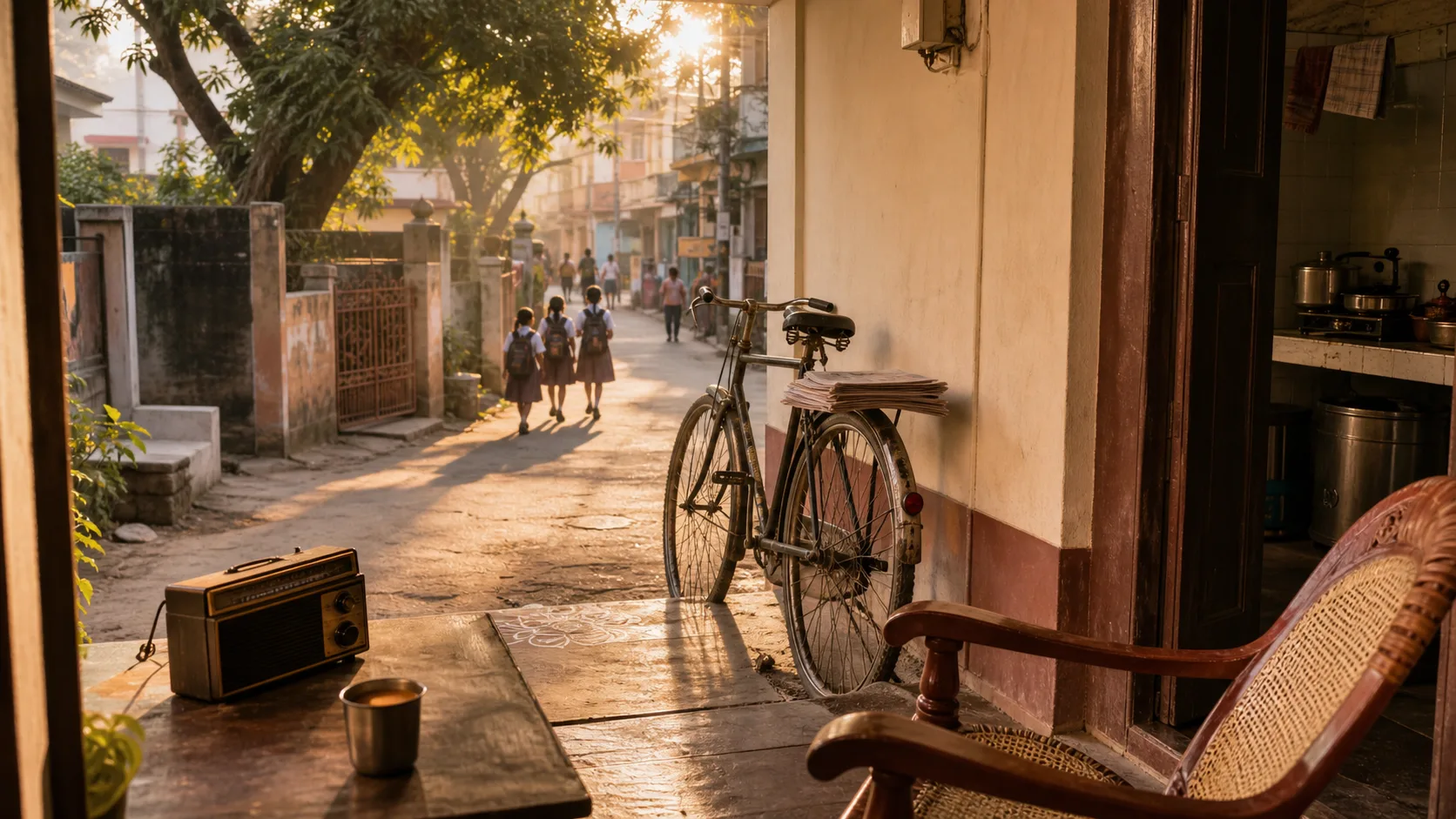
In some homes, morning arrived through Akashvani, devotional music, local news or film songs playing low enough not to be called loud and clearly enough to reach every room.
The radio did not wait for you to unlock it. It simply continued while tea was poured, uniforms were ironed and somebody asked where the newspaper had gone.
Television later joined the routine, but radio had a particular freedom. You did not need to face it. It lived alongside the work of the morning.
The street had notifications
The newspaper landed with a soft thud. A milk vendor called out or rang a bicycle bell. A vegetable seller's voice travelled down the lane before the cart appeared. Gates opened. Scooters needed a second attempt.
These sounds carried information. They told you who had arrived, what was available and whether the neighbourhood was already moving. Nobody had designed them as alerts, but that is what they were.
Birds were less polite than alarm apps
The rooster has a reputation for perfect timing that individual roosters do not always deserve. A koyal can begin beautifully and continue with remarkable confidence. Crows hold meetings that appear to require full attendance.
Bird calls mixed with human routine until it was difficult to say which one woke you. They remain among the few old morning sounds that do not need charging, pairing or permission access.
Bring one old sound back to the morning.
Paathshala Clock turns the pressure cooker, school bell, landline, temple bell, rooster and koyal into alarm choices.
Hear the soundsThe school day could be heard approaching
A bus horn from the road could transform a calm house in one second. Zips closed. Shoes were found. The last bite of breakfast became negotiable.
Then came assembly, corridor voices and the school bell. That bell divided the day so completely that hearing a similar one decades later can still create the feeling that you should be somewhere else.
It is one of the clearest examples of sound carrying memory. Read more about why familiar sounds can return us to an old scene.
The landline belonged to everyone
A mobile call belongs to the person whose name appears on the screen. A landline ring belonged to the house.
Someone had to answer it, and everyone nearby briefly wondered who it might be. An early call could mean travel plans, a relative checking in or news important enough not to wait. The ring had no contact photo, but it had presence.
Mornings are more private now
Today one person can wake to a song through a watch, another to vibration and a third to a phone placed under a pillow. The household no longer needs to begin at the same moment.
That privacy is useful. Shift workers, students and families with different schedules need it. Yet something was lost when every sound became personal and optimised. The old morning was shared, even when it was inconvenient.
This is the feeling behind Paathshala Clock. Not that the past was quieter or better. It was often noisier and less accommodating. But its sounds had texture. They belonged to people, rooms and routines rather than a folder called Default Tones.
Which sound was yours?
Perhaps your morning began with a temple bell. Perhaps it was the hiss of an iron, the call of a vendor, a train beyond the colony or your mother asking for the third time whether you were awake.
The list changes from home to home. That is the point. A remembered morning is never only a time on a clock. It is the sound that told you the day had already started.
Continue with six sounds many Indian 90s kids remember.